
Fashion moves quickly. Trends appear, collections change, and technology allows intricate designs to be reproduced faster than ever. In this fast-moving world, machine-made embroidery has become an important part of modern textile production.
Yet, handmade details continue to hold a special place in fashion.
Why?
Because handmade work brings something to fabric that cannot always be measured by speed or precision—the human touch.
More Than Just a Stitch
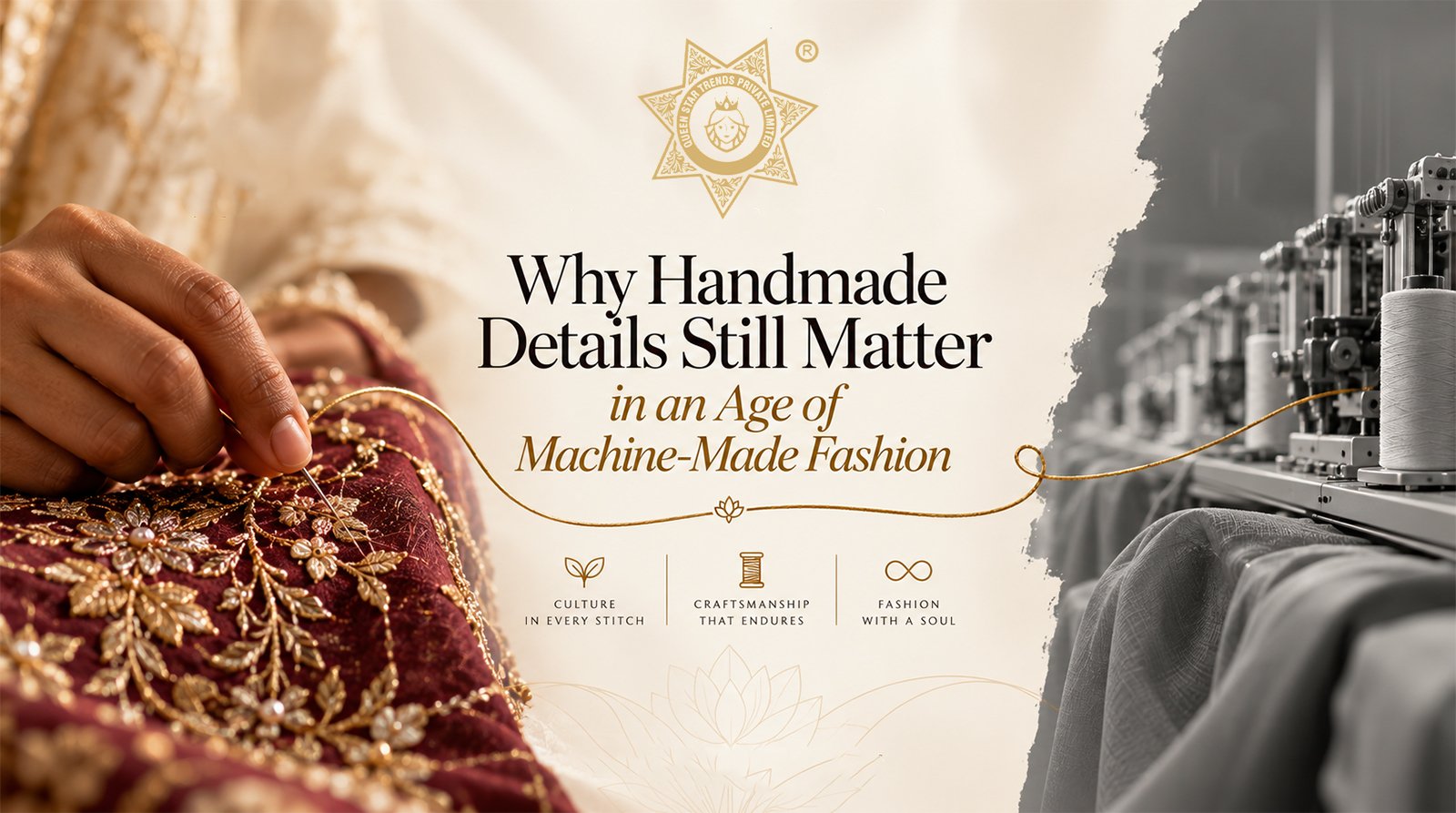
When an artisan works on a piece of fabric by hand, every stitch requires attention. The movement of the needle, the choice of thread, the placement of a motif and even subtle variations in tension contribute to the final appearance.
These small differences are often what give handcrafted textiles their character.
Machine embroidery, on the other hand, is designed for consistency. It can reproduce the same pattern across hundreds of metres with remarkable precision. For large-scale fashion production, this consistency is invaluable.
But handmade work offers a different kind of appeal: individuality.
The Beauty of Imperfection
Perfect symmetry isn’t always what makes a textile beautiful.
Slight variations in handcrafted embroidery can make a design feel more personal and authentic. Two pieces created by hand may share the same pattern but still have tiny differences in stitching, texture or finish.
In an industry increasingly focused on uniformity, these details can make a garment feel distinctive.
This is particularly valuable in occasionwear, bridal fashion, couture-inspired collections and premium garments where customers often look for something beyond a mass-produced appearance.
Where Tradition Meets Modern Fashion
Handcrafted embroidery is also a bridge between generations.
Many Indian embroidery traditions have been passed from one generation of artisans to another. The techniques may have originated decades or even centuries ago, but today’s designers are giving them new relevance.
Traditional motifs are appearing on contemporary silhouettes. Classic threadwork is being paired with modern colour palettes. Handcrafted elements are being combined with new textures and fabrics.
The craft remains rooted in tradition, while its application keeps evolving.
Can Handmade and Machine-Made Coexist?
Absolutely.
It doesn’t have to be a competition.
Machines offer speed, precision and scalability. Handmade techniques offer individuality, craftsmanship and an artisanal character. Modern textile development can benefit from both.
For fashion businesses, the choice often depends on the purpose of the collection. A large commercial range may require consistent machine embroidery, while a premium capsule collection might benefit from handcrafted details.
The most interesting possibilities can emerge when traditional craftsmanship inspires modern textile development.
Why It Still Matters to Fabric Businesses
Today’s textile buyers are not looking only at colour and price. Texture, detailing, finish and the story behind a fabric can influence how a collection is perceived.
This is where thoughtful textile development becomes important. Fabric houses and manufacturers that understand both traditional craftsmanship and contemporary fashion requirements can create materials that feel relevant without losing their sense of character.
Across Surat’s evolving textile industry, this balance between craftsmanship and modern production is becoming increasingly visible. Brands such as Queen Star Trends reflect this broader movement by exploring fabrics and surface details that bring together traditional inspiration and contemporary textile aesthetics.
Keeping the Human Touch Alive
Machine-made fashion may be faster, but handmade details remind us that fashion can also be about patience.
Every handcrafted stitch represents time, skill and attention. And when that detail becomes part of a finished garment, it carries more than visual appeal—it carries a piece of craftsmanship.
Technology may continue to transform fashion, but the human hand will always have a story worth telling.
FAQs
1. Why is handmade embroidery valued in fashion?
Handmade embroidery is valued for its craftsmanship, individuality, intricate detailing and connection to traditional textile practices.
2. Is handmade embroidery better than machine embroidery?
Neither is universally better. Machine embroidery provides consistency and scalability, while handmade embroidery offers individuality and artisanal character.
3. Is hand embroidery still relevant today?
Yes. It continues to be used in premium fashion, bridalwear, occasionwear and collections where craftsmanship and distinctive detailing are important.
4. Can handmade and machine embroidery be used together?
Yes. Many modern textile and fashion approaches combine traditional inspiration or handcrafted elements with modern production techniques.
5. Why do small handmade details make a difference?
Small variations in stitching, texture and placement can give a fabric or garment a more distinctive and artisanal appearance.
6. What types of clothing commonly use handmade embroidery?
Hand embroidery is commonly seen in sarees, lehengas, bridalwear, suits, jackets, gowns and premium occasionwear.